
Introduction
Learn for a Digital Future The world is changing faster than ever before. Technology is growing every single day, and it is transforming the way people live, work, communicate, and learn. A few years ago, many jobs depended mainly on physical effort or simple office work. Today, digital tools, artificial intelligence, online platforms, and automation are becoming part of almost every profession. Because of this, learning digital skills is no longer optional; it is becoming necessary for success in the modern world.
The digital future is not something that will happen far away in time. It is already here. People use smartphones to communicate, businesses use software to manage operations, schools use online learning platforms, and governments rely on digital systems to serve citizens. Whether someone wants to become an entrepreneur, a student, a freelancer, or an employee in a company, digital knowledge creates more opportunities.
Learning the right skills today can help people stay relevant tomorrow. It can open doors to better careers, higher income, and greater independence. Some digital skills help people get jobs, while others help them create businesses, solve problems, and connect with global opportunities.
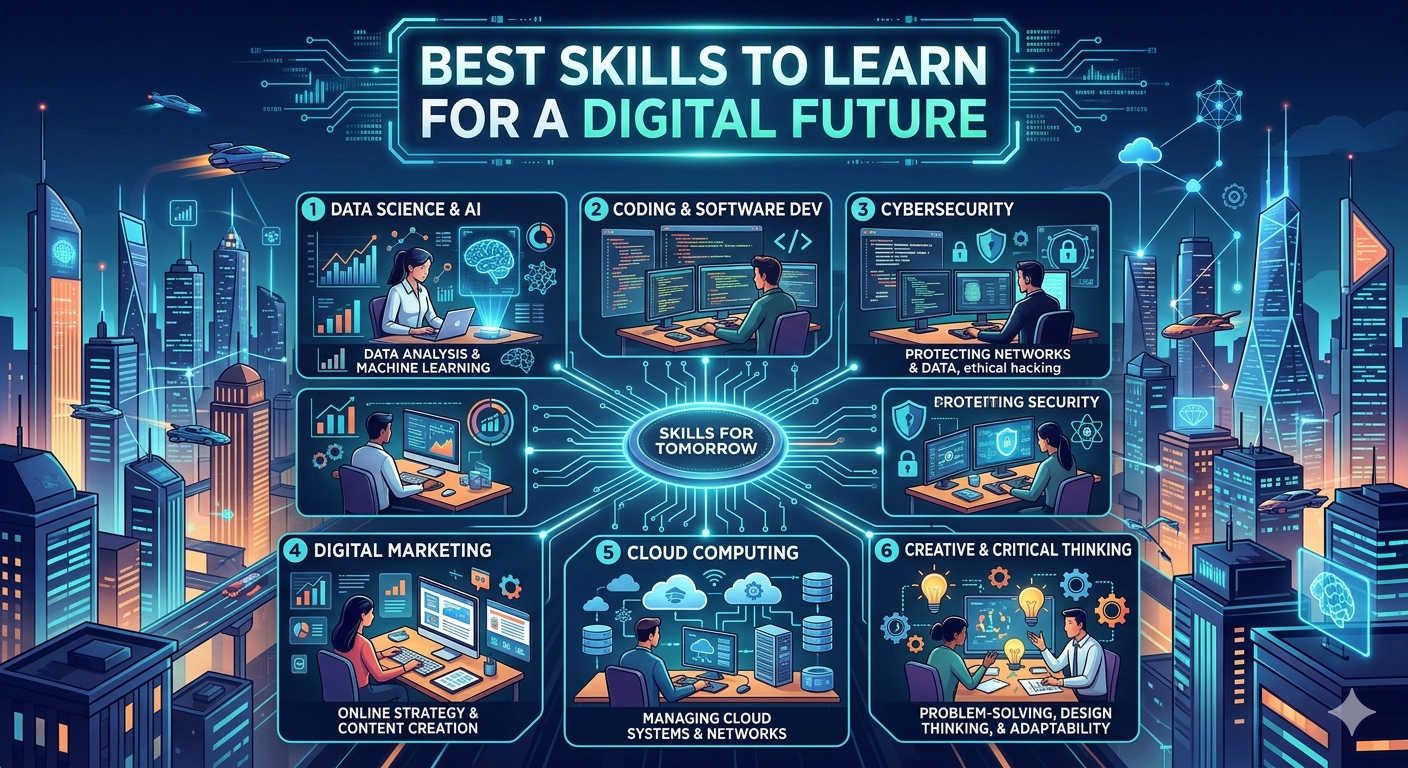
This article explains the best skills to learn for a digital future. These are practical and valuable abilities that can prepare anyone for success in the years ahead.
1. Digital Literacy, Learn for a Digital Future
What is Digital Literacy?, Learn for a Digital Future
Digital literacy is the ability to use digital devices, software, and online platforms effectively. It includes understanding how to operate computers, smartphones, the internet, and digital tools.
This is the foundation of all other digital skills.
A person with digital literacy can:
- Use a computer confidently
- Browse the internet safely
- Create and manage documents
- Send professional emails
- Search for information online
- Use apps and software efficiently
Without digital literacy, learning advanced skills becomes difficult.
Why It Matters
Digital literacy is important because almost every field now depends on technology. Schools, hospitals, businesses, banks, and government offices all use digital systems.
People who understand technology adapt faster and solve problems more easily.
How to Learn It
Start by learning:
- Basic computer operation
- File management
- Microsoft Office or Google Workspace
- Internet safety
- Email communication
Practice regularly.
2. Coding and Programming, Learn for a Digital Future
What is Coding?
Coding is writing instructions that tell computers what to do.
Programming languages include:
- Python
- JavaScript
- Java
- C++
- HTML/CSS
Coding powers websites, apps, games, software, and digital systems.
Why Coding is Important
Programming is one of the most valuable skills for the future because software runs the digital world.
Companies need programmers to build:
- Websites
- Mobile applications
- AI systems
- Databases
- Automation tools
Coding also improves logical thinking and problem-solving.
Best Programming Languages to Learn
Python
Easy for beginners and widely used for:
- AI
- Data science
- Automation
- Web development
JavaScript
Essential for web development.
Used to create interactive websites.
HTML and CSS, Learn for a Digital Future
Important for website structure and design.
How to Learn Coding
- Online tutorials
- Practice projects
- Coding challenges
- Building small applications
Consistency is key.
3. Data Analysis, Learn for a Digital Future
What is Data Analysis?
Data analysis means collecting, organizing, and interpreting data to make decisions.
Businesses use data to understand:
- Customer behavior
- Market trends
- Performance
Why It Matters
Data is often called “the new oil” because it is extremely valuable.
Organizations need people who can analyze information and turn it into useful insights.
Tools to Learn
- Excel
- SQL
- Python
- Power BI
- Tableau
Career Opportunities
Data analysis can lead to jobs such as:
- Data Analyst
- Business Analyst
- Research Analyst
It is a highly demanded skill.
4. Artificial Intelligence and Machine Learning
What is AI?
Artificial Intelligence allows machines to perform tasks that normally require human intelligence.
Examples:
- Chatbots
- Voice assistants
- Recommendation systems
Machine learning is a branch of AI where systems learn from data.
Why Learn AI?
AI is shaping the future.
Industries using AI include:
- Healthcare
- Education
- Finance
- Agriculture
- Transportation
Learning AI gives people a strong advantage.
Skills Needed
- Mathematics
- Python
- Statistics
- Data analysis
5. Cybersecurity
What is Cybersecurity?
Cybersecurity is protecting systems, devices, and data from digital attacks.
It involves preventing:
- Hacking
- Data theft
- Malware
- Online fraud
Why It Matters, Learn for a Digital Future
As digital systems grow, cyber threats increase.
Every organization needs cybersecurity professionals.
Skills to Learn, Learn for a Digital Future
- Network security
- Ethical hacking
- Encryption
- Risk assessment
Cybersecurity offers strong career opportunities.
6. Digital Marketing, Learn for a Digital Future
What is Digital Marketing?
Digital marketing is promoting products and services online.
It includes:
- Social media marketing
- Search engine optimization (SEO)
- Email marketing
- Content marketing
- Paid advertising
Why It Matters
Businesses need online visibility.
Digital marketing helps companies reach customers globally.
Benefits
This skill can help people:
- Get marketing jobs
- Start freelancing
- Grow businesses
7. Content Creation, Learn for a Digital Future
What is Content Creation?
Creating valuable digital content such as:
- Videos
- Articles
- Podcasts
- Graphics
Why Learn It?
The internet runs on content.
People and businesses need engaging content to attract attention.
Platforms include:
- YouTube
- TikTok
- Blogs
Skills Needed
- Creativity
- Writing
- Video editing
- Storytelling
Content creation can become a full-time career.
8. Graphic Design, Learn for a Digital Future
What is Graphic Design?
Graphic design is visual communication.
It includes creating:
- Logos
- Posters
- Social media graphics
- Website designs
Why It Matters
Strong visuals attract attention.
Businesses need designers for branding and communication.
Tools to Learn
- Canva
- Adobe Photoshop
- Illustrator
- Figma
Graphic design is highly useful for freelancers.
9. Video Editing, Learn for a Digital Future
Why Video Editing Matters
Video is one of the most powerful forms of communication.
People consume video daily for:
- Education
- Entertainment
- Marketing
Tools to Learn
- CapCut
- Adobe Premiere Pro
- DaVinci Resolve
Video editing is valuable for creators and businesses.
10. Communication Skills, Learn for a Digital Future
Why Digital Communication Matters
Technology connects people globally.
Good communication helps people:
- Work remotely
- Collaborate online
- Build professional relationships
Important Areas
- Email writing
- Online presentation
- Virtual teamwork
Technical skills alone are not enough.
11. Problem-Solving
Digital work often involves challenges.
Problem-solvers can:
- Analyze issues
- Find solutions
- Adapt quickly
This skill is valuable in every profession.
12. Critical Thinking
Critical thinking means analyzing information carefully before making decisions.
In the digital world, people face:
- Misinformation
- Fake news
- Misleading data
Critical thinkers make smarter decisions.
13. Adaptability
Technology changes rapidly.
A tool popular today may disappear tomorrow.
Adaptability helps people:
- Learn quickly
- Accept change
- Stay competitive
14. Project Management
Project management is organizing tasks to achieve goals.
Digital teams often work remotely.
Useful tools:
- Trello
- Asana
- Notion
This skill improves leadership.
15. Financial Literacy for the Digital Economy
Understanding money is crucial.
Digital workers should know:
- Budgeting
- Saving
- Investing
- Managing online income
Freelancers especially need this skill.
16. Entrepreneurship
The internet allows people to build businesses from anywhere.
Digital entrepreneurs can create:
- Online stores
- Apps
- Courses
- Services
Entrepreneurship creates independence.
17. Networking
Success often depends on connections.
Digital networking helps people meet:
- Mentors
- Employers
- Clients
Professional platforms help build opportunities.
18. Learning How to Learn
The most powerful skill is the ability to learn continuously.
Technology keeps changing.
People who learn quickly stay ahead.
Ways to improve:
- Read regularly
- Take courses
- Practice consistently
Challenges in Learning Digital Skills
Many people face obstacles such as:
Lack of Resources
Not everyone has easy access to technology.
Fear of Complexity
Some think digital skills are too difficult.
Lack of Consistency
Learning requires regular practice.
The solution is patience and persistence.
How to Start Learning
Step 1: Choose One Skill
Focus on one area.
Step 2: Use Free Resources
There are many free tutorials online.
Step 3: Practice Daily
Even 30 minutes helps.
Step 4: Build Projects
Apply what you learn.
Step 5: Keep Improving
Never stop learning.
The Future of Work
Future jobs will depend heavily on technology.
Many traditional roles will change.
New careers will emerge in:
- AI
- Robotics
- Digital education
- Cybersecurity
- Data science
Preparing now creates future opportunities.
Why Young People Should Start Early
Young people adapt quickly.
Starting early gives:
- More experience
- Better opportunities
- Greater confidence
Digital skills can transform live
19. Cloud Computing
What is Cloud Computing?
Cloud computing is the delivery of computing services such as storage, databases, servers, software, and networking over the internet.
Instead of storing data only on personal computers, people and companies store it online.
Examples include:
- Online file storage
- Website hosting
- Online software platforms
- Remote data access
Cloud computing allows people to access information anytime and anywhere.
Why It Matters, Learn for a Digital Future
Modern businesses rely heavily on cloud systems.
Almost every major company uses cloud technology because it offers:
- Flexibility
- Lower costs
- Easy access
- Better security
- Scalability
As more businesses move online, cloud computing skills become increasingly valuable.
Popular Cloud Platforms
Amazon Web Services (AWS)
One of the most widely used cloud platforms.
Microsoft Azure
Used by businesses worldwide.
Google Cloud Platform
Known for strong AI and analytics tools.
Career Opportunities
Cloud computing can lead to careers such as:
- Cloud Engineer
- Solutions Architect
- Cloud Security Specialist
This field offers excellent growth potential.
20. User Experience (UX) and User Interface (UI) Design, Learn for a Digital Future
What is UX/UI Design?
UX (User Experience) design focuses on how users interact with digital products.
UI (User Interface) design focuses on how digital products look visually.
Together, they ensure apps and websites are easy to use and attractive.
Why It Matters, Learn for a Digital Future
People prefer digital products that are:
- Simple
- Fast
- Beautiful
- Easy to navigate
Good design improves customer satisfaction.
Companies invest heavily in UX/UI.
Skills to Learn, Learn for a Digital Future
- Wireframing
- Prototyping
- User research
- Design thinking
- Visual hierarchy
Tools
- Figma
- Adobe XD
- Sketch
UX/UI design is excellent for creative people who enjoy solving problems.
21. Search Engine Optimization (SEO),Learn for a Digital Future
What is SEO?
SEO is the process of improving websites so they rank higher on search engines.
When people search online, they usually click the top results.
SEO helps websites appear there.
Why Learn SEO?
Businesses need traffic.
More traffic means:
- More customers
- More visibility
- More revenue
SEO specialists help businesses grow online.
Key Areas
Keyword Research
Understanding what people search for.
On-Page SEO
Optimizing website content.
Technical SEO
Improving website structure.
Link Building
Increasing website authority.
SEO is valuable for:
- Bloggers
- Business owners
- Freelancers
- Marketers
22. Blockchain Technology
What is Blockchain?
Blockchain is a digital system for recording information securely.
It is decentralized, meaning no single person controls it.
It powers technologies like:
- Cryptocurrencies
- Smart contracts
- Secure digital records
Why It Matters
Blockchain is changing industries such as:
- Finance
- Healthcare
- Supply chain
- Government systems
It improves:
- Transparency
- Security
- Trust
Skills Needed
- Programming
- Cryptography basics
- Distributed systems knowledge
Blockchain remains an important future technology.
23. Automation Skills
What is Automation?
Automation means using technology to perform tasks automatically.
Instead of doing repetitive work manually, systems handle it.
Examples:
- Automatic email responses
- Data entry automation
- Workflow systems
Why Learn It?, Learn for a Digital Future
Automation saves:
- Time
- Money
- Energy
Companies seek people who can automate tasks.
Tools to Learn
- Python
- Zapier
- Power Automate
Automation improves productivity.
24. Remote Work Skills
Why Remote Work Matters
Many companies now hire people from anywhere.
Remote work offers flexibility and global opportunities.
To succeed remotely, people need skills such as:
- Time management
- Online collaboration
- Self-discipline
- Virtual communication
Useful Tools
- Zoom
- Slack
- Google Meet
- Notion
Remote work is likely to remain a major part of the future.
25. Research Skills
What are Research Skills?
Research means finding reliable information, analyzing it, and applying it effectively.
The digital world has unlimited information.
The challenge is knowing what is accurate.
Why It Matters
Strong research skills help people:
- Learn faster
- Avoid misinformation
- Make better decisions
Good researchers stand out in every field.
26. Social Media Management
What is Social Media Management?
Managing social media accounts professionally.
Tasks include:
- Creating posts
- Scheduling content
- Engaging followers
- Tracking performance
Why Learn It?
Businesses depend on social media.
A strong online presence builds trust and visibility.
This skill is useful for:
- Freelancers
- Entrepreneurs
- Marketing professionals
27. Public Speaking in Digital Spaces
Why It Matters
Digital communication often requires speaking online.
Examples:
- Virtual presentations
- Webinars
- Online teaching
- Video content
Strong speaking skills build confidence and credibility.
28. Emotional Intelligence
What is Emotional Intelligence?
The ability to understand and manage emotions.
It includes:
- Self-awareness
- Empathy
- Communication
- Relationship management
Why It Matters in the Digital Future
Even as technology grows, human connection remains essential.
People with emotional intelligence lead teams better and collaborate effectively.
29. Decision-Making Skills
Digital environments move quickly.
People must make smart decisions fast.
Good decision-makers:
- Analyze options
- Evaluate risks
- Choose wisely
This skill is crucial for leadership.
30. Digital Ethics
What is Digital Ethics?
Digital ethics means understanding responsible behavior in digital spaces.
This includes:
- Privacy
- Fairness
- Responsible AI use
- Respect for intellectual property
Why It Matters
Technology creates ethical challenges.
People must use digital tools responsibly.
Building a Personal Learning Strategy
Learning digital skills requires a plan.
Identify Your Goal
Ask yourself:
What do I want?
Examples:
- Get a job
- Freelance
- Build a business
- Improve knowledge
Your goal shapes your learning path.
Create a Schedule
Consistency matters more than intensity.
Study:
- 30 minutes daily or
- 2 hours several times a week
Regular practice leads to progress.
Focus on Projects
Theory alone is not enough.
Build real projects.
Examples:
If learning coding:
Build a website.
If learning design:
Create sample graphics.
If learning marketing:
Run a test campaign.
Projects prove your skills.
Build a Portfolio
A portfolio shows what you can do.
It helps when applying for:
- Jobs
- Freelance work
- Internships
A strong portfolio can be more powerful than certificates.
Common Mistakes to Avoid
Trying to Learn Everything at Once
This causes confusion.
Master one skill first.
Giving Up Too Early
Digital skills take time.
Progress may feel slow.
Keep practicing.
Learning Without Application
Knowledge without practice fades quickly.
Use what you learn.
Ignoring Soft Skills
Technical ability alone is not enough.
Communication and teamwork matter greatly.
How Digital Skills Can Change Lives
Digital skills create real transformation.
They can help people:
Earn Income Online
Through:
- Freelancing
- Content creation
- Remote jobs
Access Global Opportunities
The internet removes geographical barriers.
A skilled person can work with clients worldwide.
Solve Community Problems
Technology can improve education, health, and communication.
Digital skills can create positive impact.
Build Financial Independence
People can create businesses and multiple income streams.
This gives freedom and security.
The Importance of Lifelong Learning
The future belongs to continuous learners.
Technology evolves constantly.
Skills that are valuable today may change tomorrow.
People who keep learning remain relevant.
Lifelong learning means:
- Staying curious
- Being open to change
- Improving continuously
This mindset is essential.
Final Thoughts
The digital future is filled with opportunities for those willing to prepare.
Learning digital skills is one of the smartest investments anyone can make.
Whether someone chooses:
- Coding
- Design
- Marketing
- Cybersecurity
- Data analysis
- Content creation
The key is starting.
No one becomes an expert overnight.
Success comes from:
- Patience
- Practice
- Discipline
- Consistency
The world is moving toward a digital-first economy.
Those who build digital skills today will lead tomorrow.
Every great achievement begins with a single step.
Start now.
Learn steadily.
Practice daily.
And create a future full of opportunity, growth, and success.
Real-Life Examples of Digital Success
To better understand the power of digital skills, it is helpful to look at how these skills change real lives.
Across the world, many people have transformed their future by learning digital abilities.
Some started with no experience.
Some had limited resources.
Others learned using only a smartphone and internet connection.
What made the difference was commitment.
Example 1: The Self-Taught Programmer
A young student begins learning programming online.
At first, the concepts seem difficult.
Errors appear constantly.
Progress feels slow.
But through daily practice, the student gradually improves.
After several months, they build their first website.
Later, they create small applications.
Eventually, they apply for freelance projects.
What started as curiosity becomes income.
After years of growth, that learner may become:
- A software engineer
- An app developer
- A startup founder
This journey begins with one simple decision:
To start learning.
Example 2: The Digital Entrepreneur
A person notices that local businesses need better online visibility.
They decide to learn digital marketing.
They study:
- Social media strategy
- Content creation
- SEO
- Advertising
Soon, they begin helping small businesses.
They improve customer engagement.
Sales increase.
As results grow, demand grows.
That person builds an agency.
This is how digital knowledge becomes business opportunity.
Example 3: The Content Creator
Someone enjoys teaching others.
They begin creating educational videos.
At first, very few people watch.
But consistency builds audience trust.
Over time, their content reaches thousands.
Eventually, they earn through:
- Sponsorships
- Courses
- Partnerships
- Advertising
Digital platforms reward value creation.
Example 4: The Freelance Designer
A creative learner studies graphic design.
They practice using free tools.
They design logos and posters.
Then they build a portfolio.
Soon they attract international clients.
Their skill becomes a global service.
Geography no longer limits opportunity.
Why Some People Succeed Faster
Many people start learning digital skills.
Not everyone progresses equally.
The difference often comes from habits.
Successful learners usually have:
Discipline
They study even when motivation is low.
Curiosity
They explore deeply.
They ask questions.
They seek understanding.
Patience
They accept slow progress.
They know mastery takes time.
Action
They practice instead of only reading.
Action creates improvement.
The Role of Mindset
Digital success depends greatly on mindset.
A strong mindset includes:
Growth Thinking
Believing abilities improve through effort.
People with this mindset do not fear mistakes.
They learn from them.
Resilience
Challenges are part of learning.
Every expert was once a beginner.
Persistence creates results.
Confidence Through Practice
Confidence does not come first.
Practice creates confidence.
The more people apply skills, the more capable they become.
Digital Skills and Education
Education itself is changing.
Traditional learning is no longer the only path.
Today, people can learn from:
Online Courses
Flexible and accessible.
Video Tutorials
Visual and practical.
Interactive Platforms
Learning by doing.
Digital Communities
Connecting with learners worldwide.
The internet has made education more open than ever.
The Future of Education
In coming years, education will become increasingly digital.
Students will use:
- Virtual classrooms
- AI tutors
- Interactive simulations
- Smart learning platforms
To succeed, students must become comfortable with digital learning environments.
Digital Transformation Across Industries
Technology is changing every field.
Healthcare
Doctors use digital systems for:
- Patient records
- Diagnosis support
- Telemedicine
Healthcare workers need digital competence.
Agriculture
Modern farming uses:
- Smart sensors
- Data analysis
- Automated systems
Digital agriculture improves productivity.
Banking
Financial systems rely on digital platforms.
Skills in fintech are increasingly valuable.
Education
Teachers use online tools for instruction.
Digital teaching skills are essential.
Business
Companies use technology for:
- Communication
- Sales
- Data tracking
- Customer service
Digital knowledge drives business growth.
The Global Nature of Digital Work
One of the biggest advantages of digital skills is global access.
A person in one country can:
- Work for a company abroad
- Serve international clients
- Sell products globally
- Build worldwide networks
This creates enormous possibilities.
Digital ability removes many traditional barriers.
Why Language Skills Also Matter
In the digital world, communication is essential.
English is especially valuable because much online learning content is in English.
Improving language skills increases access to:
- Courses
- Documentation
- Professional opportunities
Combining digital and language skills creates strong advantage.
How to Stay Motivated While Learning
Motivation often changes.
Some days learning feels exciting.
Other days it feels difficult.
The solution is systems, not dependence on emotion.
Set Small Goals
Instead of aiming too big immediately, focus on manageable progress.
Example:
Learn one concept daily.
Small wins build momentum.
Track Progress
Record what you learn.
Seeing improvement encourages consistency.
Celebrate Milestones
Finishing a project is progress.
Recognize it.
Join Communities
Learning with others creates encouragement.
Support helps persistence.
The Power of Consistency
Consistency beats intensity.
Studying one hour every day is more effective than studying ten hours once a month.
Digital skills develop through repeated exposure.
Daily practice strengthens understanding.
Building Confidence Through Projects
Projects transform theory into ability.
Examples include:
For Coding
Build:
- A calculator
- A website
- A task manager
For Design
Create:
- Posters
- Brand logos
- Social media templates
For Marketing
Develop:
- Campaign strategies
- Sample advertisements
- Analytics reports
Projects prove skill.
Why Failure is Necessary
Many learners fear mistakes.
This slows growth.
Failure is part of mastery.
Every error teaches something.
In coding, errors reveal logic issues.
In design, weak work teaches better structure.
In communication, mistakes improve clarity.
Progress comes through correction.
Digital Skills and Financial Freedom
One of the strongest benefits of digital ability is financial opportunity.
Digital skills allow people to create income beyond traditional employment.
Examples:
Freelancing
Providing services directly to clients.
Selling Digital Products
Such as:
- Templates
- Courses
- E-books
Remote Employment
Working online for organizations.
Building Platforms
Creating websites, apps, or communities.
These opportunities can create independence.
Advice for Beginners
If you are just starting, remember these truths:
You Do Not Need to Know Everything
Focus on one skill.
You Can Start Small
Even basic learning matters.
Progress Takes Time
Patience is essential.
Practice Matters More Than Perfection
Done is better than perfect.
Everyone Starts as a Beginner
Experts were once learners.
A Vision of the Digital Future
The coming years will bring:
- Smarter AI systems
- More automation
- Virtual reality experiences
- New forms of communication
- Advanced digital businesses
This future will reward prepared individuals.
Those who learn now will adapt faster.
Those who delay may struggle to catch up.
Preparation creates advantage.
Extended Conclusion
The digital future is not waiting.
It is unfolding now.
Every day, technology changes how the world works.
The most valuable response is preparation.
Learning digital skills is not only about employment.
It is about empowerment.
It is about gaining the ability to:
- Create
- Innovate
- Solve problems
- Build opportunities
- Shape the future
The skills discussed throughout this article are more than technical abilities.
They are tools for transformation.
A person who learns digital skills gains more than knowledge.
They gain confidence.
They gain independence.
They gain possibility.
The journey may not always be easy.
There will be moments of confusion.
There will be challenges.
There will be mistakes.
But persistence turns effort into mastery.
And mastery opens doors.
The best time to begin was yesterday.
The next best time is now.
Take the first step.
Stay consistent.
Keep learning.
The digital future belongs to those who prepare for it.
Practical Roadmap for Mastering Digital Skills
Knowing which skills to learn is important.
But knowing how to learn them step by step is even more important.
Many people fail because they try to learn without a clear direction.
A roadmap gives structure.
It shows where to begin and how to progress.
Below is a practical path for anyone who wants to prepare for the digital future.
Phase One: Building Foundations
This is the beginner stage.
At this point, the goal is to become comfortable with technology.
Strong foundations make advanced learning easier.
Step 1: Master Basic Computer Skills
Before learning advanced digital topics, a person should confidently understand basic computer use.
This includes:
File Management
Knowing how to:
- Create folders
- Save files
- Organize documents
- Move and delete files
Good organization saves time.
Typing Skills
Fast and accurate typing improves efficiency.
Practice daily.
Typing is essential for:
- Writing
- Coding
- Communication
Internet Navigation
Learn how to:
- Search effectively
- Use browsers
- Bookmark resources
- Identify reliable information
This is a core digital survival skill.
Basic Software Use
Become familiar with tools such as:
- Word processors
- Spreadsheets
- Presentation software
These are widely used professionally.
Step 2: Learn Digital Communication
Communication is critical.
Focus on:
Professional Email Writing
Learn:
- Clear subject lines
- Respectful tone
- Proper structure
Online Collaboration
Understand how to work with others digitally.
Use tools for:
- Meetings
- Shared documents
- Messaging
Digital Etiquette
Professional online behavior matters.
This includes:
- Respectful communication
- Clear responses
- Timeliness
Phase Two: Choosing a Core Skill
After foundations, choose one main digital skill.
Trying to learn too many at once causes confusion.
Choose based on interest.
Option 1: Programming Path
Best for logical thinkers.
Focus on:
- Python
- JavaScript
- Web development
Career opportunities:
- Software development
- Automation
- App creation
Option 2: Design Path
Best for creative thinkers.
Focus on:
- Graphic design
- UX/UI
- Branding
Career opportunities:
- Design freelancing
- Product design
- Digital branding
Option 3: Data Path
Best for analytical thinkers.
Focus on:
- Data analysis
- SQL
- Visualization
Career opportunities:
- Data analytics
- Business intelligence
Option 4: Marketing Path
Best for strategic communicators.
Focus on:
- Social media
- SEO
- Advertising
Career opportunities:
- Digital marketing
- Brand strategy
Option 5: Cybersecurity Path
Best for detail-oriented problem solvers.
Focus on:
- Security fundamentals
- Networking
- Ethical hacking
Career opportunities:
- Security analysis
- Risk management
Phase Three: Structured Learning
Random learning slows progress.
Create structure.
Daily Study Routine
A strong daily routine might include:
30 Minutes Learning Theory
Reading or watching lessons.
60 Minutes Practice
Applying concepts.
30 Minutes Review
Reinforcing understanding.
Regular practice compounds over time.
Weekly Goals
Examples:
Week one:
Learn basics.
Week two:
Complete exercises.
Week three:
Build mini-project.
Week four:
Review and improve.
Small goals create momentum.
Phase Four: Project Development
Projects turn learning into skill.
Without projects, knowledge remains incomplete.
Beginner Projects
Simple but practical.
Examples:
For Coding
- Calculator
- To-do app
- Portfolio page
For Design
- Logo creation
- Event poster
- Website mockup
For Marketing
- Sample social campaign
- SEO analysis
Intermediate Projects
More challenging.
Require independent thinking.
Advanced Projects
Professional-level work.
These become portfolio highlights.
Phase Five: Building a Portfolio
A portfolio proves ability.
Employers and clients trust demonstrated work.
What to Include
Showcase:
- Best projects
- Clear descriptions
- Tools used
- Lessons learned
Keep It Professional
A strong portfolio is:
- Organized
- Clear
- Focused
Quality matters more than quantity.
Phase Six: Real-World Experience
Learning becomes powerful when applied professionally.
Freelancing
Take small projects.
This builds:
- Experience
- Confidence
- Income
Internships
Gain industry exposure.
Learn professional workflows.
Volunteer Work
Help organizations.
Build skills while contributing value.
Phase Seven: Continuous Improvement
Digital learning never truly ends.
Technology evolves.
Stay updated through:
- Reading
- Practice
- Community engagement
Growth requires consistency.
Overcoming Common Learning Challenges
Every learner faces obstacles.
Success depends on response.
Challenge 1: Feeling Overwhelmed
Solution:
Break learning into small parts.
Progress step by step.
Challenge 2: Lack of Motivation
Solution:
Rely on discipline.
Motivation changes.
Systems endure.
Challenge 3: Comparing Yourself to Others
Solution:
Focus on personal progress.
Comparison slows growth.
Challenge 4: Fear of Failure
Solution:
View mistakes as lessons.
Improvement requires experimentation.
How to Learn Faster
Efficiency matters.
Learn by Doing
Active practice beats passive watching.
Teach Others
Explaining strengthens understanding.
Take Notes
Writing reinforces memory.
Repeat Key Concepts
Repetition builds mastery.
Time Management for Digital Learners
Many learners balance other responsibilities.
Smart time use matters.
Prioritize Important Tasks
Focus on high-impact learning.
Remove Distractions
Limit unnecessary interruptions.
Study Consistently
Small daily effort produces large long-term gains.
Building a Digital Reputation
In the digital age, reputation matters.
People evaluate work online.
Build a positive presence.
Create Professional Profiles
Showcase skills clearly.
Share Valuable Work
Demonstrate expertise.
Engage Respectfully
Professional interaction builds trust.
Why Persistence Wins
Talent matters less than consistency.
A person practicing daily often surpasses naturally talented but inconsistent learners.
Persistence compounds.
Every session builds capability.
Every challenge builds resilience.
Every project builds confidence.
Over time, small efforts create extraordinary results.
The Long-Term Benefits of Digital Mastery
Digital skills create lasting value.
Benefits include:
Career Security
Adaptability protects employability.
Higher Income Potential
Specialized digital ability is valuable.
Flexibility
Work opportunities increase.
Global Access
Reach opportunities beyond local limitations.
Creative Freedom
Build and create independently.
Inspiration for the Journey
Every major expert once knew nothing.
Every successful creator once started at zero.
What separates achievers is not perfection.
It is persistence.
Learning digital skills is like planting seeds.
Growth may seem invisible at first.
But with steady effort, results appear.
Then progress accelerates.
The key is staying consistent long enough to experience transformation.
Final Extension
The digital future is not built by people who wait.
It is built by people who learn.
Every skill learned today becomes an advantage tomorrow.
Every hour invested compounds into opportunity.
The world is changing rapidly.
This change creates challenges.
But it also creates enormous possibility.
Those who prepare become leaders.
Those who adapt become valuable.
Those who persist create their future.
Start where you are.
Use what you have.
Learn what you can.
Improve daily.
And step confidently into the digital future with knowledge, discipline, and purpose.
Deep Dive Into the Most Valuable Digital Career Paths
Learning digital skills becomes even more powerful when connected to clear career paths.
Many learners ask:
“After learning these skills, what can I actually become?”
This is an important question.
A skill becomes more meaningful when it connects to real opportunities.
The digital economy offers many career options.
Some are highly technical.
Others focus more on creativity, strategy, or communication.
Below is a deeper exploration of some of the most valuable digital career paths of the future.
1. Software Development
What Software Developers Do
Software developers create digital systems that solve problems.
They design and build:
- Applications
- Websites
- Operating systems
- Business tools
- Mobile apps
They write code that allows technology to function.
Why This Career is Important
Software powers modern life.
Almost every device depends on software.
Because of this, software development remains one of the strongest career choices.
Demand continues to grow.
Skills Required
Important skills include:
Programming Languages
Such as:
- Python
- JavaScript
- Java
- C++
Problem-Solving
Developers constantly solve technical challenges.
Logical Thinking
Coding requires structured thinking.
Types of Software Development
Front-End Development
Building the visible part of websites.
Focuses on design and user interaction.
Back-End Development
Building the systems behind websites.
Focuses on databases and servers.
Full-Stack Development
Combining front-end and back-end skills.
Mobile App Development
Creating apps for smartphones.
Why It Is a Strong Future Career
Software will continue expanding into every industry.
This career offers:
- High demand
- Global opportunities
- Freelance potential
- Strong earning possibilities
2. Data Science
What Data Scientists Do
Data scientists analyze large amounts of information.
They discover patterns and insights.
Their work helps organizations make smarter decisions.
Why It Matters
Data drives modern decision-making.
Businesses rely on information to:
- Predict trends
- Understand customers
- Improve performance
Data science transforms raw numbers into valuable knowledge.
Skills Needed
Statistics
Understanding patterns.
Programming
Especially Python.
Data Visualization
Presenting findings clearly.
Machine Learning
Building predictive models.
Career Potential
Data science is highly respected because it combines technical ability with business insight.
Industries needing data scientists include:
- Healthcare
- Finance
- Technology
- Education
3. Artificial Intelligence Engineering
What AI Engineers Do
AI engineers build systems that simulate intelligent behavior.
Examples include:
- Recommendation systems
- Language models
- Image recognition tools
Why AI Engineering Matters
Artificial intelligence is transforming the world.
Its influence continues expanding rapidly.
Organizations need professionals who understand how to build intelligent systems.
Required Skills
- Python
- Mathematics
- Machine learning
- Neural networks
Future Outlook
AI is expected to shape:
- Medicine
- Education
- Transportation
- Business automation
This makes AI engineering one of the most promising careers.
4. Cybersecurity Analysis
What Cybersecurity Analysts Do
They protect digital systems.
Their responsibilities include:
- Monitoring threats
- Preventing attacks
- Investigating vulnerabilities
Why This Career is Growing
As technology grows, cyber threats increase.
Security is now essential.
Every organization needs protection.
Key Skills
- Network security
- Risk assessment
- Ethical hacking
- Incident response
Advantages of This Career
Cybersecurity offers:
- Strong demand
- High responsibility
- Excellent growth opportunities
5. Digital Marketing Strategy
What Digital Marketers Do
They help organizations reach online audiences.
They manage:
- Social media campaigns
- Search visibility
- Advertising strategy
- Customer engagement
Why It Matters
Digital visibility determines business success.
Without online reach, businesses struggle.
Digital marketers help brands grow.
Skills Needed
- Content strategy
- SEO
- Analytics
- Advertising
Career Opportunities
Possible roles:
- Marketing strategist
- Social media manager
- SEO specialist
- Brand consultant
6. UX/UI Design
What Designers Do
They create digital experiences that feel intuitive and visually effective.
Their work focuses on:
- Simplicity
- Accessibility
- Visual communication
Why It Matters
People expect digital products to be easy to use.
Good design improves trust and satisfaction.
Skills Required
- Design principles
- User psychology
- Wireframing
- Prototyping
Career Benefits
This field combines creativity and technology.
It is ideal for creative problem-solvers.
7. Cloud Engineering
What Cloud Engineers Do
They design and maintain cloud systems.
They ensure data and services are accessible online.
Why It Matters
Organizations increasingly rely on cloud infrastructure.
Cloud expertise is essential for modern operations.
Skills Needed
- Cloud platforms
- Networking
- Security
- System architecture
Future Potential
Cloud engineering is expected to remain highly valuable for decades.
8. Content Strategy and Digital Media
What Content Professionals Do
They create and manage digital communication.
This includes:
- Articles
- Videos
- Educational materials
- Brand storytelling
Why It Matters
Information is one of the internet’s most valuable resources.
Strong communicators thrive online.
Skills Needed
- Writing
- Storytelling
- Audience understanding
- Editing
Career Possibilities
- Content strategist
- Writer
- Media producer
- Educator
9. Product Management
What Product Managers Do
They guide digital product development.
They connect technical teams with business goals.
Responsibilities
They:
- Define product direction
- Coordinate teams
- Prioritize features
Why It Matters
Digital products need strategic leadership.
Product managers ensure products solve real problems.
Skills Needed
- Communication
- Strategy
- Analysis
- Leadership
10. Digital Entrepreneurship
What Digital Entrepreneurs Do
They create businesses using technology.
Examples include:
- Online education platforms
- Digital agencies
- Software startups
- E-commerce businesses
Why This Path Matters
Entrepreneurship offers freedom.
It allows people to create their own opportunities.
Skills Needed
- Innovation
- Marketing
- Financial understanding
- Adaptability
Choosing the Right Career Path
Not every path fits every person.
Choosing wisely matters.
Ask yourself:
What fi I Enjoy?
Interest sustains long-term learning.
What Are My Strengths?
Choose paths aligned with natural abilities.
What Problems Do I Enjoy Solving?
Different careers solve different challenges.
What Lifestyle Do I Want?
Some careers offer more flexibility.
Others offer more structure.
Combining Multiple Skills
The strongest professionals often combine abilities.
Examples:
Developer + Designer
Builds visually strong software.
Marketer + Data Analyst
Creates smarter campaigns.
Content Creator + SEO Specialist
Builds stronger digital visibility.
Programmer + Entrepreneur
Creates innovative businesses.
Why Adaptability is the Ultimate Career Skill
Technology changes quickly.
Specific tools evolve.
But adaptable people remain valuable.
Adaptability means:
- Learning new systems
- Accepting change
- Evolving continuously
This may be the most important digital survival skill.
Preparing for Long-Term Success
Long-term digital success requires more than technical knowledge.
It requires:
Discipline
Consistent effort.
Curiosity
Continuous exploration.
Patience
Mastery takes time.
Resilience
Challenges are inevitable.
Closing Reflection
The digital future offers extraordinary possibilities.
It creates opportunities for creators, thinkers, builders, and innovators.
The path may look complex.
But every expert began as a beginner.
Every skill starts with a first lesson.
Every career begins with a first step.
Success belongs to those who begin, continue, and persist.
The digital world is expanding.
Its opportunities are growing.
Those who invest in learning today are investing in tomorrow.
Start learning.
Stay consistent.
Keep building.
And create a future defined by growth, opportunity, and achievement.
The Role of Discipline in Digital Success
Discipline is one of the most powerful forces behind success in the digital world.
Many people believe success depends mainly on intelligence or talent.
While talent can help, discipline is far more important.
Talent may create a strong beginning.
Discipline creates long-term achievement.
The digital world rewards people who consistently improve.
Technology changes quickly.
New systems appear.
Old tools become outdated.
Only disciplined learners remain prepared.
Discipline allows a person to continue learning even when motivation fades.
This is what separates temporary interest from real mastery.
Why Motivation Alone Is Not Enough
Motivation feels powerful.
It creates excitement.
It inspires action.
But motivation is temporary.
Some days it is strong.
Other days it disappears.
If learning depends only on motivation, progress becomes inconsistent.
Discipline is different.
Discipline creates action regardless of emotion.
It allows a learner to continue even when:
They feel tired.
They feel confused.
They feel discouraged.
This consistency creates growth.
Small repeated effort compounds into major results.
Building Discipline Through Daily Action
Discipline is not something people are born with.
It is developed.
It grows through repeated action.
The simplest way to build discipline is through daily commitment.
For example:
Studying every day for a short period.
Practicing one concept consistently.
Completing one task at a time.
These small actions train the mind.
Over time, discipline becomes natural.
The Connection Between Discipline and Freedom
Some people think discipline limits freedom.
The opposite is true.
Discipline creates freedom.
A person disciplined enough to learn valuable digital skills gains:
More career options.
More income opportunities.
More flexibility.
More independence.
Without discipline, opportunities remain limited.
With discipline, possibilities expand.
Managing Distractions
The digital age offers incredible tools.
It also offers endless distractions.
Social media.
Entertainment.
Notifications.
Constant interruptions.
These distractions weaken focus.
Strong learners protect their attention.
They create environments that support concentration.
This might include:
Turning off notifications.
Creating quiet study space.
Setting focused learning periods.
Protecting attention is protecting progress.
Focus as a Competitive Advantage
Focus has become increasingly rare.
Many people constantly divide their attention.
This reduces deep learning.
The ability to focus deeply is now a major advantage.
Focused learners understand concepts faster.
They retain information better.
They produce stronger work.
Focus accelerates mastery.
The Power of Consistency Over Intensity
Some learners study intensely for short periods.
Then they stop.
Others study moderately but consistently.
The second approach is stronger.
Consistency builds lasting skill.
For example:
One hour daily for one year creates enormous growth.
This steady progress often surpasses irregular bursts of effort.
Digital mastery is built through consistency.
Learning Through Repetition
Repetition strengthens understanding.
The brain learns through repeated exposure.
A learner may not fully understand something the first time.
That is normal.
Repeated practice creates clarity.
This is especially important for:
Programming.
Design principles.
Data analysis.
Technical systems.
Mastery requires revisiting concepts.
Overcoming Frustration
Frustration is part of learning.
Every digital learner experiences moments of difficulty.
A program may fail.
A design may look wrong.
A concept may feel confusing.
These moments test commitment.
The disciplined learner responds by continuing.
Frustration often signals growth.
It means the brain is being challenged.
Persistence transforms confusion into understanding.
Delayed Results
Digital learning often produces delayed rewards.
A learner may study for weeks without obvious progress.
This can feel discouraging.
But growth is often invisible at first.
Then suddenly, understanding deepens.
Skills connect.
Confidence rises.
This is why patience matters.
Trust the process.
Results come through sustained effort.
Self-Belief and Persistence
Discipline works best when paired with belief.
A learner must trust that effort matters.
Progress may be slow.
But consistent effort always creates change.
Belief fuels persistence.
Persistence creates mastery.
Mastery creates opportunity.
Creating a Long-Term Vision
A clear vision strengthens discipline.
When learners understand why they are learning, commitment increases.
Possible visions include:
Building a successful career.
Creating financial independence.
Launching a business.
Developing innovative solutions.
A strong purpose creates resilience.
Purpose gives effort meaning.
The Importance of Responsibility
Digital growth requires personal responsibility.
Successful learners do not wait for perfect conditions.
They begin with what they have.
They adapt.
They improve.
Responsibility means owning progress.
It means recognizing that growth depends largely on personal action.
This mindset creates power.
Learning Beyond Comfort Zones
Growth happens outside comfort.
Comfort feels safe.
But comfort rarely creates transformation.
Progress often requires:
Trying difficult projects.
Facing uncertainty.
Making mistakes publicly.
Taking intellectual risks.
These experiences strengthen capability.
They expand potential.
Digital Confidence Through Practice
Confidence in digital work is built through evidence.
The more a learner practices, the more confidence develops.
This confidence becomes visible in:
Decision-making.
Problem-solving.
Communication.
Creativity.
Confidence is not something to wait for.
It is something to build.
Discipline in Professional Life
The same discipline used for learning supports career success.
Professionals succeed through:
Reliability.
Consistency.
Continuous improvement.
Strong work ethic.
Digital employers and clients value disciplined individuals.
Skill matters.
Dependability matters equally.
Turning Effort Into Excellence
Excellence is rarely sudden.
It is the result of repeated intentional effort.
Each lesson contributes.
Each project adds experience.
Each challenge develops resilience.
Over time, these efforts create remarkable ability.
What seems impossible today can become natural tomorrow.
Why Persistence Always Matters
The digital world changes quickly.
Some learners quit when progress feels slow.
Others continue.
The ones who continue eventually stand out.
Persistence creates separation.
It turns average effort into exceptional outcomes.
The learner who refuses to stop gains enormous advantage.
A Final Reflection on Growth
Every major achievement begins quietly.
A single lesson.
A single project.
A single hour of focused effort.
These small beginnings often feel insignificant.
But they compound.
Over time, they create expertise.
Digital success is not built through sudden breakthroughs.
It is built through repeated disciplined action.
Keep showing up.
Keep practicing.
Keep learning.
Keep growing.
The effort you invest today is building the future you will live tomorrow.
Trusted External Learning Resources
Below are five reliable platforms you can use to learn digital skills:
1. Coursera
Offers online courses in coding, data science, artificial intelligence, and digital marketing from top universities and companies.
2. freeCodeCamp
A free platform to learn programming, especially web development and software engineering through hands-on practice.
3. Google Digital Garage
Provides free training in digital marketing, career development, and online business skills.
4. Cisco Networking Academy
Offers high-quality courses in cybersecurity, networking, and IT fundamentals.
5. Khan Academy
A free learning platform covering mathematics, computing, and basic digital concepts.
You can include these links in your article as credible references to support your discussion on digital skills.
Conclusion
Learn for a Digital Future The digital future is already here, and it is growing every day. Technology is no longer something special or separate from daily life—it is part of everything we do. Because of this, learning digital skills has become one of the most important steps a person can take to build a better future.
From basic computer knowledge to advanced fields like programming, artificial intelligence, data analysis, cybersecurity, and digital marketing, every skill plays a role in shaping opportunities. These skills are not just for experts or professionals; they are for anyone who is willing to learn, practice, and improve.
The most important lesson is this: success in the digital world does not come instantly. It is built slowly through consistent effort, patience, and discipline. Small actions done every day can lead to big results over time. Even starting with simple steps can eventually lead to strong careers, financial independence, and global opportunities.
Challenges will always exist. Learning may sometimes feel difficult or slow. Mistakes will happen. But every mistake is part of growth. Every challenge is part of progress. Those who continue despite difficulties are the ones who succeed in the end.
The digital world rewards learners, creators, problem-solvers, and thinkers. It rewards people who are ready to adapt, explore, and keep learning throughout their lives. There is no final stage of learning in technology because it is always changing.
So the most important decision is to start now. Do not wait for the perfect time, because the perfect time is created through action. Begin with small steps, stay consistent, and keep building your skills day by day.
Your future in the digital world depends on what you do today.
Ogummaa Interneetii Bu’uuraa Hunda Namni Beekuu Qabu
Primary Keywords for SEO – Hiika, Faayidaa fi Akkamitti FilatamuEasy to Expand into 500–1500 Word Posts → Meets Google Content Standards
High Relevance to Digital Skills & ICT Niche → Attracts High CPC
Baayyee namatti tola jabaadhu